Showing posts with label local fruits. Show all posts

Wednesday, June 15, 2011

PINEAPPLE JUICE


Pineapple Juice as Drinks

Do you know that pineapple juice can improve the taste of your sperm?

What is the best way to enjoy the pineapple juice?

I can tell you how to do it. Remember this is my theory only. But I have had enjoyed the taste and love it so much just with this simple ways:-

Get a ripe pineapple. You may smell the ripe one easily. Peel off the skin and cut the bottom part, about one third of the fruit. This is to take out the sour portion of the fruit.

Next, cut the fruit into small portion for blending purposes. Remember to take out the trunk in the middle of the fruit.

Blend them. Now you have the pure sweet pineapple juice without sugar.

Do it yourself at home.

Remember cut off one third of the fruit if you want to enjoy the sweet pineapple juice.

Friday, May 27, 2011

PINEAPPLE

PINEAPPLE FRUIT


Do you know what pineapple fruit can give to you?

Pineapple (Ananas comosus) is the common name for a tropical plant and its edible fruit, which is actually a multiple fruit consisting of coalesced berries.[1] It was given the name pineapple due to its resemblance to a pine cone.[2] The pineapple is by far the most economically important plant in the Bromeliaceae.[3] Besides being produced for consumption, it can be grown as an ornamental or houseplant, obtained from the crown of a supermarket fruit.[4] Some sources say that the plant will flower after about 24 months and produce a fruit during the following six months,[5] while others indicate a 20-month timetable.[4]

Pineapple can be consumed fresh, canned or juiced and can be used in a variety of ways. It is popularly used in desserts, salads (usually tropical fruit salads, but it can vary), jams, yogurts, ice creams, various candies, as a complement to meat dishes and in fruit cocktail. The popularity of the pineapple is due to its sweet-sour taste. The core of the pineapple is continuous with the stem supporting the fruit and with the crown, a feature unique among cultivated fruits.[6]


Unlike commonly thought, pineapple is used for many other things aside from consumption. In the Philippines, pineapple leaves are used as the source of a textile fiber called piña. This fiber can used in a variety of ways such as a wall paper and a component of furnishings.[7]


Raw pineapple is an excellent source of manganese (45% DV in a 100 g serving) and vitamin C (80% DV per 100 g).[12] Mainly from its stem, pineapple contains a proteolytic enzyme, bromelain, which breaks down protein. If having sufficient bromelain content, pineapple juice can thus be used as a marinade and tenderizer for meat. Pineapple enzymes can interfere with the preparation of some foods, such as jelly or other gelatin-based desserts, but would be destroyed during cooking and the canning process. The quantity of bromelain in the fruit is probably not significant, being mostly in the inedible stalk. Furthermore, an ingested enzyme like bromelain is unlikely to survive intact the proteolytic processes of digestion.

Traditional Medical Use

Both the root and fruit may be eaten or applied topically as an anti-inflammatory or as a proteolytic agent. In some practices, it may be used to induce abortion or menstruation or as an antihelminthic agent. Bromelain purified from pineapple stem or fresh juice, then provided in the diet over 6 months, decreased the severity of colonic inflammation in mice with experimental colitis.

Wednesday, April 27, 2011

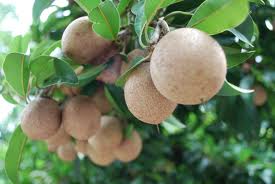
Local Fruits - Ciku/Sapodilla


Ciku/Sapodilla

Sapodilla, or ciku as called in Malaysia is the edible fruit of Manilkara zapota (formerly Achras zapota), of the family Sapotaceae. The fleshy, brown fruit is the size of a small tomato, and has the mixed flavor and texture of cinnamon, apple, and pear. Ciku is also called as Sawo Manila in Indonesia, Chico in Mexico and Naspero in Venezuela.


The fruits are very astringent when young and must be fully ripened and soft to be eaten. The latex of the sapodilla plant is also the source of chicle, the name  for the chewing gum of the Aztecs. The gum obtained from the latex of the sapodilla tree (Manilkara zapota) are used in manufacturing boots and machine belts and other related products in tropical American countries or regions. 


Sapodilla is an evergreen tree measuring 15–20 m tall, and has ovate or elliptic leathery leaves and small, white flowers. The rounded or oval fruits, which measure 5–10 cm across, contain 2 to 4 hard black seeds( usually not more than 5 seeds in a single fruit). Apart in tropical Asian countries, the sapodilla also grows in tropical rain forests of Central and South America; where it is cultivated in all tropical countries as a fruit and industrial plant. The milky juice obtained from the bark contains 20–25 percent of a substance closely related to gutta-percha, which is used to manufacture chewing gum too.


The ciku fruits will ripe between 6 to 8 months from the date of flowering and it is best for harvesting when approaching the eight month. The newly harvested fruits normally are not ready for direct consumption as it needed times to ripe. In my place the newly plucked fruits will be wrapped with newspapers or old clothes and stored in a container such as boxes or big vases for a period of 2 days. Matured fruits will be ripened within 2 days and will taste much more sweeter than the immature fruits.  


The best way to enjoy the ripen ciku is to peel of the skin and keep it in the freezer for 1 or 2 hours. But do not let it frozen. Keeping it inside the refrigerator is advisable.


The name of ciku is synonym in Malaysia, to the extent of the government's agency called FELDA has a palm oil plantations by the name of FELDA Ciku located in the state of Kelantan.

KRF Kak Mie

My Blog List

Powered by Blogger.